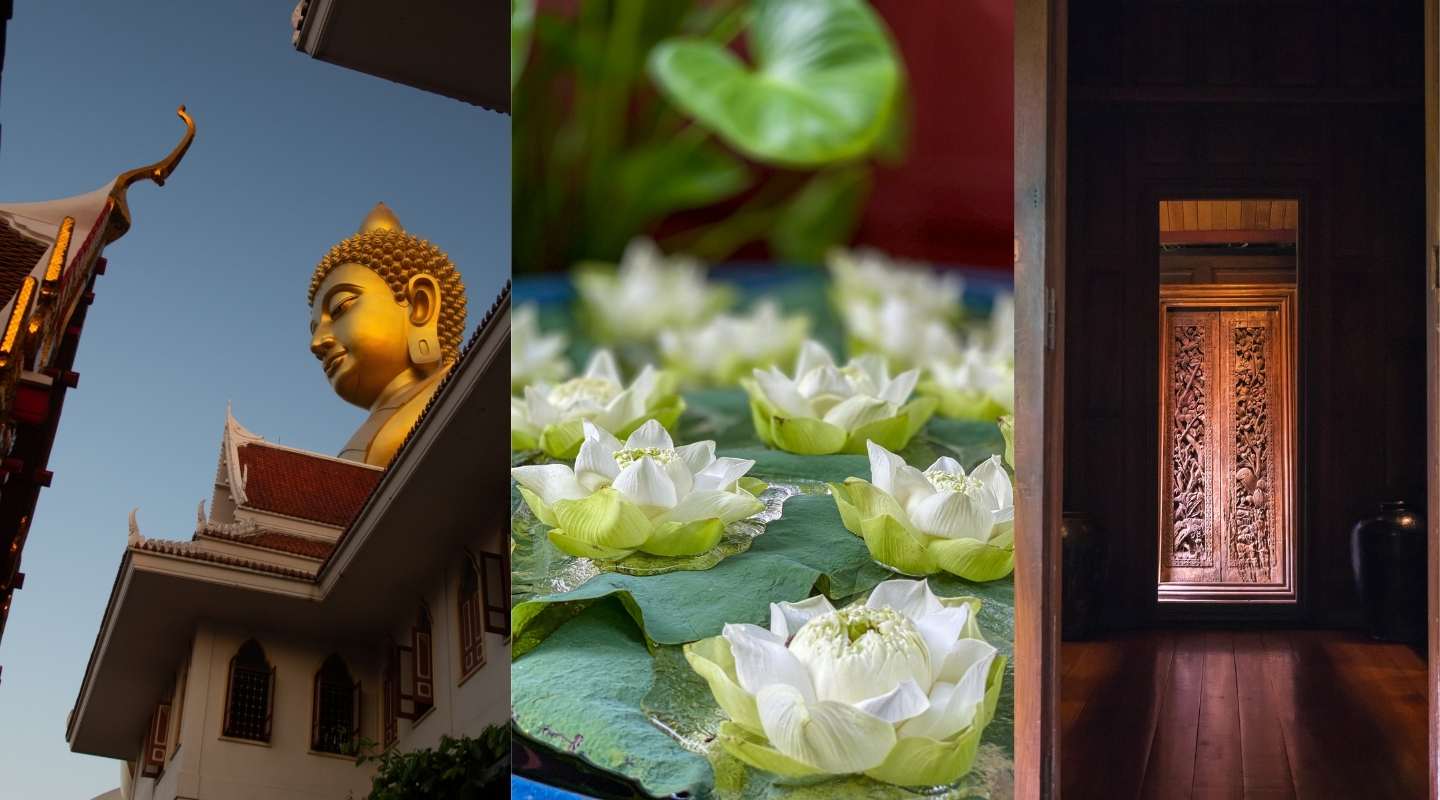
As anyone who has visited Bangkok in August can testify, the humidity is a monster – thick, oppressive and unrelenting. Yet for Jim Thompson, stepping off a military plane in August 1945, it felt like coming home. His initial plan for entry into Thailand was actually via parachute. He and a few others were to leave by plane from Calcutta with the intention to jump, but that plan was scuppered when the pilot discovered via the radio that the Japanese had surrendered. With the war over, Thompson instead found himself on the hot runway of Bangkok, met by an alien city teeming with the raw aftermath of war.
Everywhere was chaos and opportunity, punctuated by the shouts of street vendors and the chime of temple bells drifting up the Chao Phraya River that snakes through the city like a network of capillaries. Thompson, still only 39, had arrived as an officer of the Office of Strategic Services, the wartime precursor to the CIA. His mission was to front the Bangkok station and support the Free Thai Movement against Japanese occupation. He had no idea how Thailand would steal his heart.
Born James Harrison Wilson Thompson on 21 March 1906 in Greenville, Delaware, a life of inherited privilege awaited young Jim. His father was a successful textile manufacturer, a fact that would prove manifestly important even if Jim couldn’t see it at the time. In 1928, Thompson graduated from Princeton, where he was a keen rower and even represented the United States in sailing at the Amsterdam Olympics.

He pursued architecture studies at the University of Pennsylvania, though he never finished the degree or passed his licensing exams. Nevertheless, that didn’t stop him designing elegant East Coast homes while in New York, and he became interested in stage and costume design while on the board of the Ballet Russe de Monte Carlo. He was a ball of fearless energy and something of a wild card, but by his mid-thirties this scattergun approach to life had left him restless, a liberal among conservatives, and increasingly at odds with the buttoned-down expectations of the class he was born into.
War means a lot of different things to different people, most of them never good, but for the wide-eyed Thompson looking for direction in life, it gave him purpose. He served with distinction in North Africa and Europe, then found himself in Ceylon (now Sri Lanka) training for operations in Thailand. When Japan surrendered, Thompson was among the first Allied officers to reach Bangkok.
When most soldiers returned home, Thompson felt drawn by the city’s multitude of opportunities, as well as a raucous community of expats who were making their own rules in this nascent world. He briefly tried restoring the Oriental Hotel, but the partnerships with his associates soured. He learned during the restoration that the Thai silk industry was on its knees.
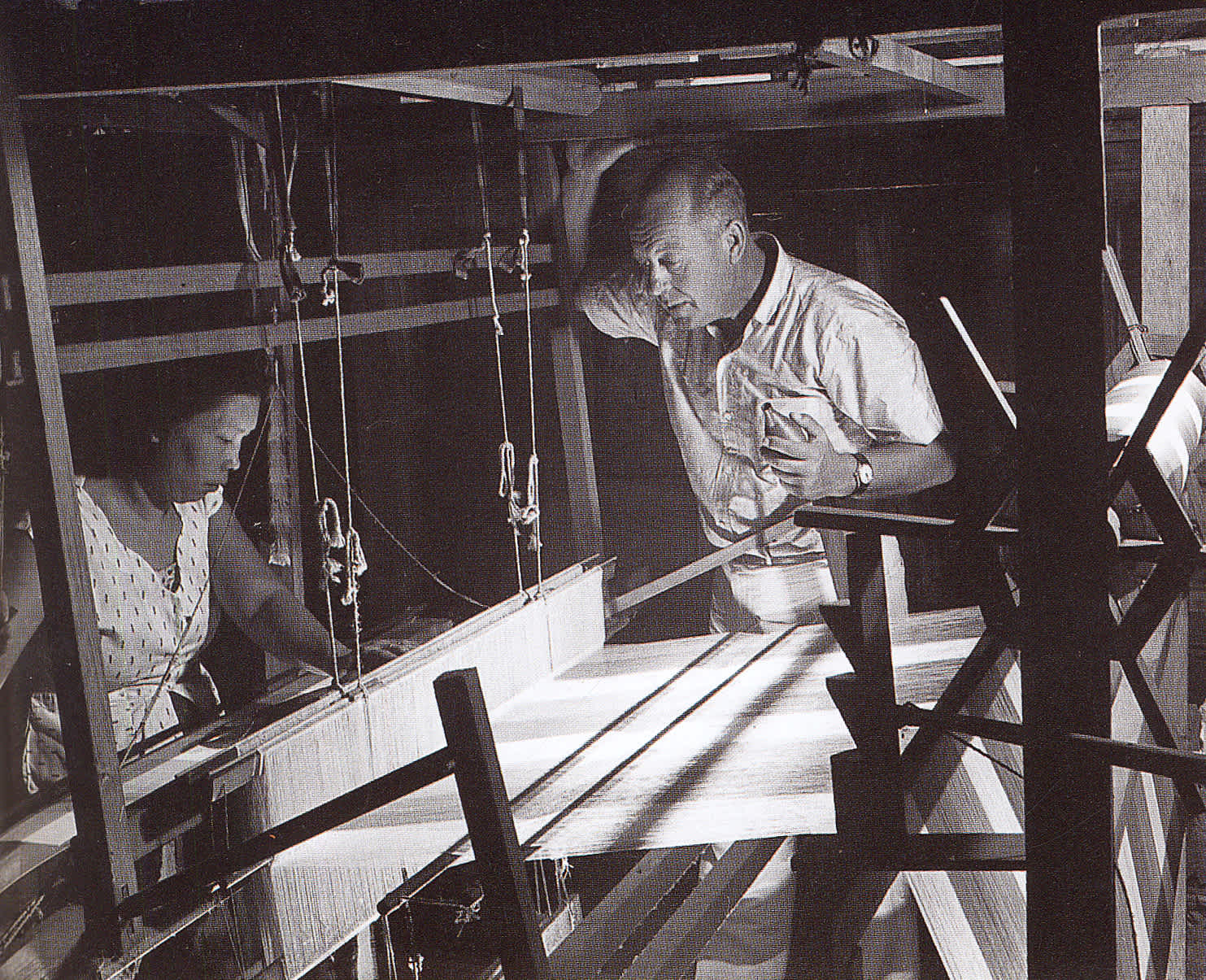
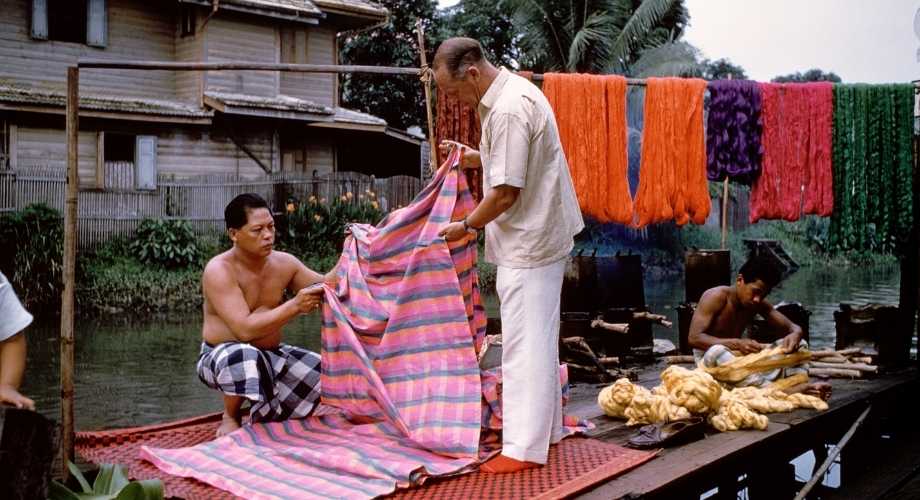
In the villages along the khlongs (canals) particularly Ban Khrua, home to Muslim Cham weavers, Thompson encountered a craft that had once been vibrant but was now fading. Traditional hand-loomed silk existed, yet production was small-scale, the colours muted, and the market almost entirely local. Imported fabrics dominated the industry and the amateurish Thai producers couldn’t compete with the economies of scale.
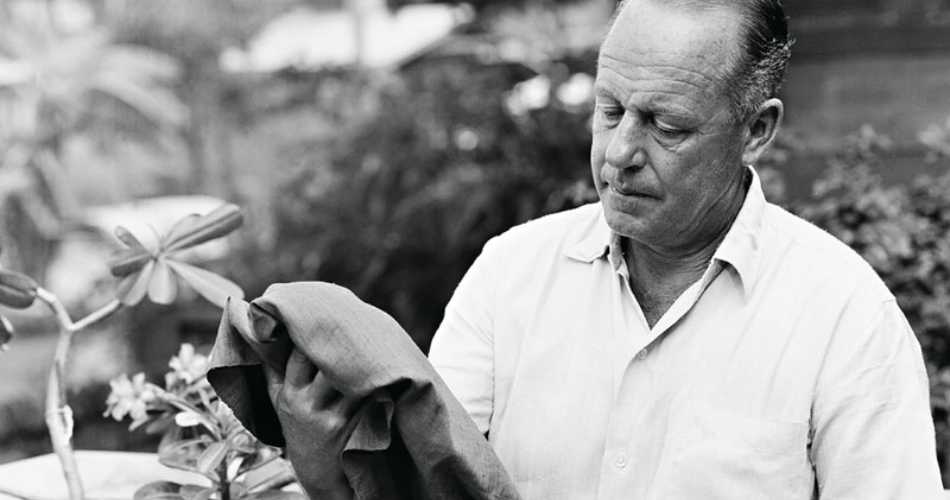
With an architect’s eye and a textile heir’s instinct, Thompson saw an opportunity. In 1951, he founded the Thai Silk Company Limited with only $25,000 in capital, insisting the venture remain majority Thai-owned. He introduced brighter colours and bolder patterns while preserving the traditional weaving methods which made for a superior product. He paid weavers fair wages while keeping production cottage-based to ensure the highest quality of cloths. Behind the scenes, Thompson was using his connections to relentlessly market his silks to Western buyers.
It was a tough sell in the late 40s, but Thompson was like a dog with a bone. With a modicum of commercial improvements, the business was on a reasonable trajectory but, ‘reasonable’ was not a word that Thompson was satisfied with. In the end, serendipity proved the catalyst for the momentum Thompson was craving – designer Irene Sharaff chose Thompson’s silks for the costumes of Rodgers and Hammerstein’s 1951 musical The King and I, a hit on Broadway that turned Thai silk into a global fashion trend.
By the mid-1950s, Thompson was shipping to couturiers and decorators worldwide, garnering the moniker ‘The Silk King’. If the silk industry was a small pond, it had just found itself a big fish that loved to make a splash. Thompson’s dinner parties in Bangkok were legendary, initially being candlelit gatherings at the Oriental Hotel where one might have a diplomat sat to the left and a Hollywood star to the right one night, with literary stars and Thai royalty on another. Thompson also collected Southeast Asian art, from Ming porcelain and Khmer stone carvings to Thai Buddhist sculptures and Burmese lacquerware.
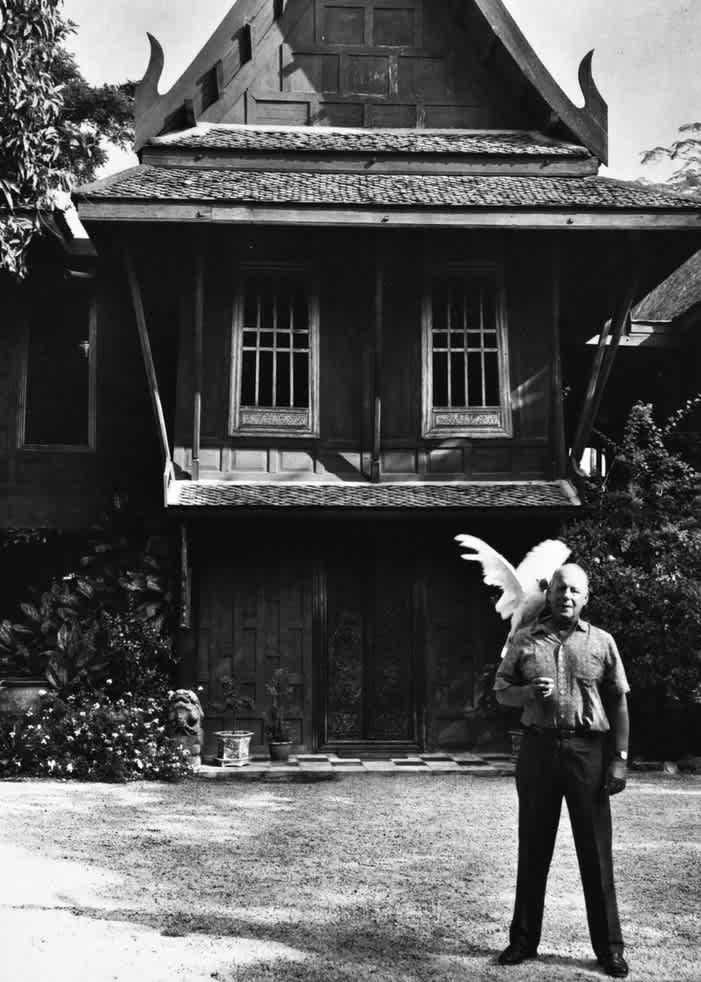
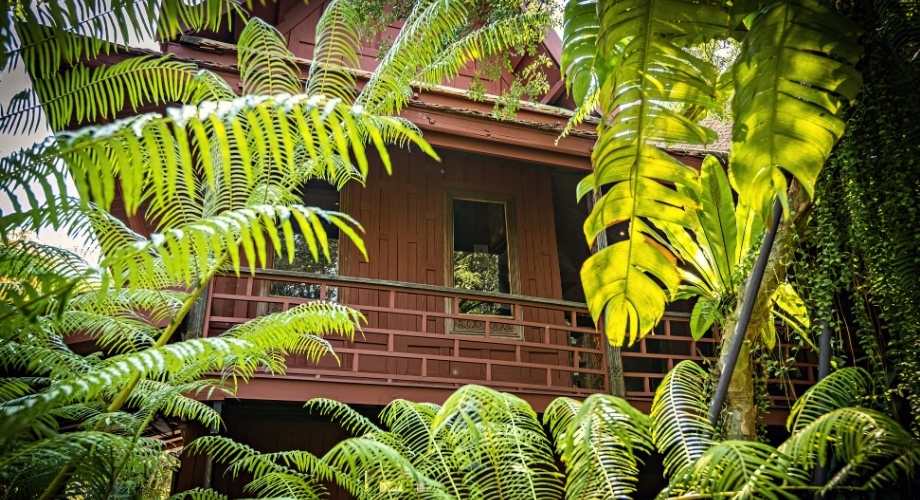
In 1958, requiring a more substantial abode, Thompson’s architectural passion began to conceive a masterpiece. He acquired six traditional antique Thai teak houses, some of them more than a century old, from Ayutthaya, the second capital of the Siamese Kingdom, as well as from the weaving village of Ban Khrua itself. He had them dismantled, floated down the river, and carefully reassembled on a beautiful plot beside a canal in what is now the Pathum Wan district of central Bangkok.
Thompson raised the entire complex on stilts for flood protection and ventilation, reversed many of the weathered interior wall panels so their aged, carved beauty faced inward, and connected the separate houses into one flowing residence with a dramatic central indoor staircase, a bold Western touch in a culture where staircases traditionally remained outdoors. Buddhist monks blessed the completed house on 3 April 1959.
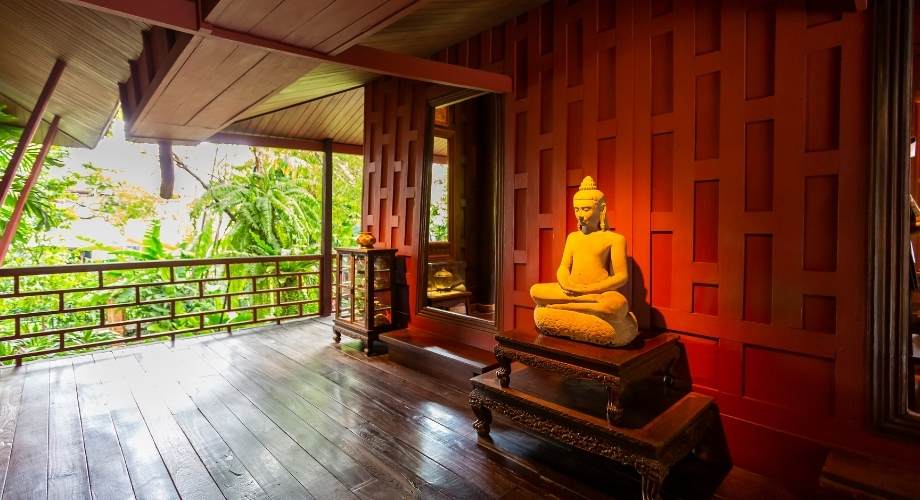
Inside, the effect was nothing short of theatrical. The soaring living room, formed from the largest weaver’s house from Ban Khrua, opened directly onto the khlong with crystal chandeliers salvaged from old Bangkok palaces glittering above polished teak floors. Low Thai-style seating was draped in vibrant silks. The dining room featured two antique Chinese gaming tables pushed together to create a generous Western-style table.
Everywhere, Thompson’s extraordinary art collection brought even more drama to the space: Khmer stone heads gazed from niches, Ming porcelain glowed in cabinets, Burmese lacquerware and Thai Buddhist sculptures caught the light, while antique silk hangings told stories of Buddha’s life and Vessantara Jataka tales. The house felt both intimate and grand, a lived-in museum that remains one of Bangkok’s most evocative landmarks – a quiet, teak-scented rebuke to the glass-and-steel skyline that has grown up around it.
For all his business acumen and ebullient socialising, Thompson was an intensely private man which inevitably led to the grinding of the rumour mill. The notion that he maintained quiet ties to American intelligence agencies as he built his silk empire was a common one. After all, he was a powerful American ideally positioned during the tense years of the Cold War and the early stirrings of conflict in Vietnam. Some even said he had sympathies for the communists.
On 24 March 1967, Thompson flew to the Cameron Highlands in Malaysia for an Easter weekend with old friends. The party included his close companion Constance ‘Connie’ Mangskau and their hosts, Singaporean chemist Ling Tien Gi and his American wife Helen. They stayed at a cozy Tudor-style cottage surrounded by luscious tea plantations and very dense jungle. Cool mountain air and hiking trails in all directions offered a welcome escape from Bangkok’s pressure cooker and gave Thompson the chance to unwind in an environment that made him feel alive.
The group attended morning service on Easter Sunday at All Souls’ Church. After enjoying a casual picnic lunch, Thompson announced that he was going for a walk, which was not out of the ordinary by any means. Despite being very social, Thompson was fond of his own company and an experienced hiker.
Seeking an afternoon of solitude in the jungle did not raise any eyebrows as he set off down the access road around 1:30 pm. He was seen briefly about 2km away near Jalan Besar. A cook at a nearby mission bungalow spotted him around 4pm. Then nothing.
When he had not returned by nightfall, concern turned to alarm. Over the following days and weeks, more than 500 people, including Malaysian police, army trackers, Orang Asli indigenous guides, Gurkha soldiers, British servicemen, and even mystics and psychics combed the rugged terrain. Bloodhounds were brought in. Helicopters hovered overhead. Rewards were offered. No trace of Thompson was ever found: no clothing, no footprints, no sign of struggle. He had left behind his cigarettes, lighter, pills for a gall-bladder condition, wallet and passport at the bungalow. It was as if the jungle had simply swallowed him up.
It wasn’t long before the rumour mill found some new gears. Communist insurgents from the Malayan Emergency must have kidnapped him. Sore business rivals in the cut-throat silk trade had surely taken him out. It was a CIA extraction gone wrong, or the intelligence agency had grown fearful of Thompson’s influence in the region and decided to nullify it. Some were more pragmatic – it must have been a tiger attack, a fall into an animal trap, or even a hit-and-run on one of the winding and notoriously dangerous mountain roads.
Hopes were briefly raised in 1985 when a small collection of bone fragments were discovered in a shallow grave near the busy resort town of Brinchang, but they were never conclusively linked to Thompson, or even declared human remains for that matter. Further muddying the story is the fact that the fragments have since disappeared during an office move, preventing any DNA testing. In 1974 a Thai court declared Thompson legally dead some seven years after his final fateful hike.
Six months after his disappearance, his sister Katharine was beaten to death in her Delaware home – a crime that was never solved. And four years after that, her son Harrison committed suicide. The conspiracies continued apace.
Jim Thompson was a real-life Le Carré character – a conduit between worlds in a time of seismic political and cultural change. In reviving the Thai silk industry he helped shape a modern Thai identity that celebrated its own craftsmanship on the global stage. Visitors to Bangkok can still feel that legacy. Stroll along the shaded paths near the Jim Thompson House or glide along the Chao Phraya aboard a river taxi, and you can sense the same palimpsest of a city that once captivated a restless American maverick.
Anantara is proud to partner with the Jim Thompson silk brand with the new Soul of Siam fashion collection. Created exclusively for Anantara by Jim Thompson, it is now available to purchase and wear at our hotels and resorts in Thailand.
[FIND OUT MORE]

.jpeg)
.jpeg)
.jpg)